






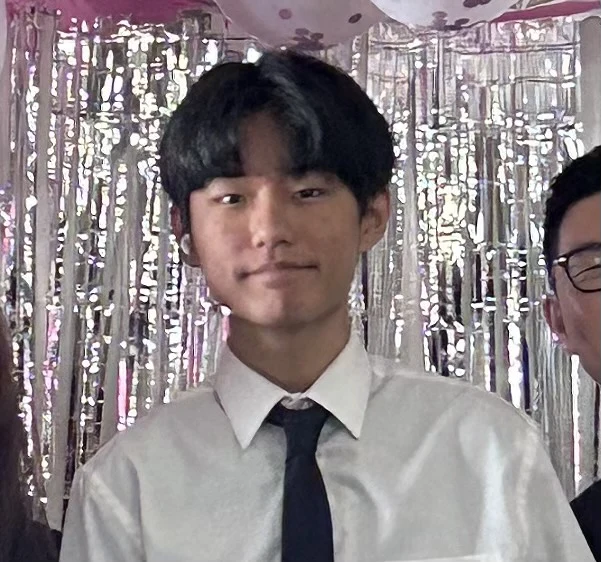
Brandon Baek in a white shirt and tie

About me

I’m a Korean-American student researcher. I study how AI can do more with less—fewer questions, fewer checks, smaller models—without leaving anyone out.

La Crescenta, CA Korean-American

Research

연구

Three papers, one question: how little can a system use and still guarantee the result for every group it serves? Increasingly, my focus is representation learning: what a compressed representation keeps, and who it leaves out. I wrote the nestedness paper alone and was first author on ExactPHQ and RECHECK-ED.

Independent research · 2026

The Price of Nestedness in Group-Robust PCA

Working paper · Manuscript not yet public

Solo author

Brandon Baek

Proofs and certified experiments · Public overview

One code. Every size. Every group.

Many AI systems compress data into a short code and add more numbers when a bigger budget is available, so the first few numbers have to work on their own. This is called a nested representation; Matryoshka embeddings work this way. My paper asks what that convenience costs when one code has to serve several populations, and we judge it by the group it serves worst.

ProofsHow large the price can get, and when some price is unavoidable
AuditsCertified measurements on image, sensor, and text data

Best at each size is not the same as best for all sizes.

If each size could choose its own directions, it would pick whatever protects the worst-off group at that size. A nested code cannot: the size-2 code has to keep the size-1 direction. The price of nestedness compares the nested code’s worst-group error with the best separate code, size by size.

A toy example: three groups, three directions

Worked out by hand to explain the idea. It is not a result from the paper.

Share of each group’s signal the code keeps

Group A33%
Group B33%
Group C33%

Prove it first, then check it on real data.

The paper bounds how large the price of nestedness can get, builds examples that show when some price is unavoidable, and separates the cost of nesting itself from the cost of imperfect optimization. It then audits fitted data and pretrained nested text-embedding models with certificates: guaranteed ranges for the true cost, not just point estimates.

Bound

How large can the price get, however many groups or sizes there are?

Construct

When is some price impossible to avoid?

Certify

How large is it on real data, with guaranteed error bars?

Working paper

The manuscript, its exact bounds, and its numerical results are not public yet. This page explains the question and a hand-worked toy example; it does not report the paper’s findings.

Smaller should not mean unfair.

Nested codes let one model serve a phone and a server, a quick search and a careful one. If shrinking the code quietly shortchanges one group, that cost should be measured and bounded, not assumed away. The same question runs through all of my research: how little can a system use and still keep its promise to everyone?

The Coding School · High School AI Research Program · 2025

An Unsupervised Analysis of Linguistic Personas in Movie Reviews

Program research paper · Presented at Columbia University

Solo author

Brandon Baek

Not just what reviewers think, but how they write.

My first research paper, written the summer after ninth grade. Sentiment analysis sorts reviews into positive and negative. I asked whether writing style alone, with no labels, could reveal distinct kinds of reviewers, and whether those groups behave differently.

49,586IMDB reviews after cleaning
5reviewer personas identified

Turning style into numbers.

I measured 18 stylometric features from earlier personality research, such as punctuation, pronouns, long words, and vocabulary richness, then merged highly correlated features into 8 core ones. I clustered the reviews with K-Means, BIRCH, and Gaussian mixture models, chose five clusters with the elbow method, and named each cluster by reading samples from it.

Five ways to review a movie.

Academic Dissector

Analytical and detailed: a quieter version of the Flaw Ranter.

Candid

Blunt, direct, and personal, with simpler everyday vocabulary.

Emotional

Strong feelings and clear recommendations: “see it” or “skip it.”

Flaw Ranter

Long, often frustrated breakdowns of what the film got wrong.

Structured Critic

Organized by category, comparative, and balanced.

People mix styles, but patterns hold.

The personas overlapped heavily and clustering scores were modest, because reviewers rarely stick to one style. Patterns still held: emotional reviewers gave the most extreme ratings, personas leaned toward different genres (horror for the analytical groups, comedy and romance for emotional reviewers), and sentiment was balanced within every persona, so writing style is independent of whether a review is positive or negative.

Only K-Means separated Candid from Emotional reviewers; BIRCH and the mixture model merged them.

Where it led

This project started my research path. It looked at how different groups of people express themselves; my later work asks how AI systems can serve every one of those groups, with guarantees.

ExactPHQ

ExactPHQ: Certified Stopping with Learned PHQ-9 Ordering

IEEE ICDM 2026 · Teen Research Track · Accepted · Camera-ready complete

Shenyang, China

First author · Collaborative research

Brandon Baek · Tevyn Yong · Seonho Kim

Learning orders. Bounds decide.

ExactPHQ asks a narrow question: can fewer PHQ-9 items determine the same binary threshold class as all nine? A learned policy chooses what to ask next. A deterministic certificate alone decides when to stop.

25.22%fewer questions · primary external replay
262,144fixed patterns verified · zero class errors

These are retrospective question counts and exact fixed-response score classification, not clinical equivalence.

The stopping certificate

For answered items, L is the observed sum. With m unanswered items scored 0–3, U = L + 3m. At T = 10, stop positive if L ≥ T; stop negative if U < T. Otherwise another response is necessary. Model confidence cannot narrow these bounds.

Follow the paper’s worked example

A fixed response vector from Table 2. This illustrates score bounds, not a screening tool.

I9 ?I1 ?I2 ?I3 ?I4 ?4 more
[0, 27]The threshold is unresolved.

Item 9 is captured first. That protocol does not establish suicide-risk assessment or a safety intervention.

Freeze, replay, replicate.

We developed policies on adult NHANES 2017–2018 records, locked them, and replayed complete responses on two different cycles. The newer cycle is the primary external evaluation; the earlier cycle adds replication.

5,068Development · 2017–2018
5,455Evaluation · 2021–2023
5,134Replication · 2015–2016

Empirical dynamic programming plans future question cost. Secondary policies use a categorical MADE density or a compact latent-class mixture. Learning changes the order, never the stopping rule. Later searches are exploratory because they reuse already examined cohorts.

A smaller learning gain, honestly shown.

Where the question savings come from

Survey-weighted mean questions. All four policies preserve the binary class for fixed responses.

Full PHQ-99.000
Optimal fixed order6.741
Empirical DP · primary6.731
MADE DP · exploratory6.650

n = 5,455 adults · Mean questions out of nine

Most savings come from certified stopping and a good fixed order. In the primary cohort, empirical DP saves only 0.010 questions beyond optimal fixed ordering. Exploratory MADE saves 0.090 beyond fixed and 0.041 beyond an independent-item model.

All 4⁹ fixed patterns had zero class errors in independent exhaustive traces. Preserving five severity bands instead required 8.394 questions in the newer cohort.

What the guarantee covers

The guarantee is exact binary score emulation for a fixed response vector. It does not say a person will give the same responses after reordering. A prospective study would need to measure response consistency, time, dropout and distress, with independent human escalation rules.

  • No claim of diagnosis, time savings, or prospective clinical equivalence.
  • The binary threshold guarantee does not preserve an exact total or complete severity assessment.
  • The work was coauthored by Brandon Baek, Tevyn Yong and Seonho Kim.

RECHECK-ED

Learning Physiological Visibility to Time Repeated Emergency Nursing Reassessments

IEEE BigData 2026 · High School Symposium · Accepted · Camera-ready in preparation

Phoenix, Arizona

First author · Collaborative research

Brandon Baek · Seonho Kim · Tevyn Yong

A change can disappear before the next check.

RECHECK-ED studies when to place one already permitted flexible nursing reassessment. It combines recent waveform support with the probability that a visible change ends within 20 minutes, while keeping required checks fixed.

+9.0 ppcapture versus fixed +40 · equal check budget
11 fewerendpoint-negative prompts versus raw monitoring

A retrospective information-capture study, not a trial of outcomes, nurse workload, or safety.

Timing without moving the protected checks

Two patient-separated, five-member gradient-boosted ensembles estimate waveform-rule support q and 20-minute disappearance e from past information only. Their product q × e forms a short-horizon urgency heuristic. Missing waveforms cannot reassure the controller: an active raw-monitor event triggers a check.

One flexible check. A protected deadline.

Select an offset to inspect the frozen holdout action trace. These are block counts, not a patient simulation.

+120

556 / 648 blocks selected +60 min

Minutes within each complete two-hour block. Initial and +120 checks stay fixed; required and urgent checks are never movable. This repeats in later complete blocks.

Patients separated. Method frozen.

The method was developed on 450 previously opened MC-MED waveform episodes across 412 patients. Model files, thresholds, code and waveform inventory were frozen before a one-time evaluation on 600 new episodes from 567 different patients.

600selected holdout episodes
402met the waveform rule
200qualified and not already chart-represented

The other 202 waveform-qualified episodes were already chart-represented. Thirty-one of the 600 episodes had no complete waveform overlap. The case-enriched, single-center sample does not estimate general ED event prevalence.

Capture and selectivity are different gains.

Same check budget. Different information capture.

200 eligible endpoints; 1,671 attempted checks per policy.

The model preserves the raw monitor’s 70 captures while reducing endpoint-negative prompts from 67 to 56.

The model’s +9.0 percentage-point difference from fixed timing has a patient-cluster 95% interval of 5.08–13.07. Capture is overlap with the simulated reassessment, not a measured clinical response.

The raw-monitor trigger captured the same 70 episodes as the model. Learning’s incremental result was 56 endpoint-negative triggered actions instead of 67—not fewer total attempted checks. Retrained no-waveform and process-only models also captured 70, with 62 and 60 endpoint-negative prompts.

0.950waveform-support AUROC
0.75320-minute expiry AUROC
0protected-check violations

A research prototype, governed by nurses.

The result supports monitor-responsive timing and a smaller set of endpoint-negative prompts under a fixed experimental budget. It does not establish that nurses missed events, that prompts were unnecessary, or that waiting would be safe. Required, urgent, post-medication and post-procedure checks cannot be moved.

  • PPG pulse quality cannot confirm arterial oxygen saturation.
  • The replay leaves physiology, treatment and historical documentation unchanged.
  • Prospective work needs nursing review, local permissions, override rules and measured patient outcomes.

Projects

작업

Small models and useful tools, made with free GPUs and other people in mind.

Full record

Choose a collection to browse. Search is here if you need something specific.

Topic

Loading archive…

What I’m working on next
01GovGuideNavigating local government, with clarity.In development

A government-navigation project focused on making local government processes easier to understand.

View project →
02Deep learning courseMachine learning and deep learning, built on basic calculus.In development

A machine learning and deep learning course built around basic calculus and core concepts. Not yet published.

View project →
GitHub

Community

함께

AI ethics, education, music, and community service.

01

HumanityOverAI

Founder & leader

I founded and lead a ten-person student organization making AI ethics education accessible through curriculum, public events, community challenges, and research.

  • Designed a 56-question AI perception survey with 1,651+ responses across 27 countries; a formal report is in development.
  • Presented at an expo and educated 120+ adults about AI’s impact.
  • Built team workflows and AI ethics lessons, and organized an awareness challenge with about 22 participants.
02

Korean American Music Academy

Regional student president

Since 2025, I’ve served as regional student president at KAMA, a Korean-American music nonprofit supporting community causes, including bone marrow donor searches and musicians with disabilities.

  • Led 20 students across events, rehearsals, and community performances.
  • Planned four major events, including concerts and banquets, and conducted three concerts.
  • Raised funds for bone marrow transplant awareness and musicians with disabilities.
  • Expected to take on the full student presidency in 2027.
03

Homemade Delights

Co-founder & head of marketing

I co-founded and co-lead a nine-person organization connecting mental health awareness with community service. I lead marketing, research-backed writing, outreach, and events.

  • Helped raise $2,500+ for local charities, including $600 for mental health awareness, and supported sales of 500+ baked goods.
  • Supported a 55-question survey with 2,300+ responses across 30+ countries; helped the team win a $750 survey contest.
  • Wrote about half of roughly 300 research-backed articles in one year and organized holiday baking and donations for people in need.
04

Machine learning & deep learning teaching

Teacher · Course developer

My teaching now focuses on machine learning and deep learning. I’m developing a course that builds on basic calculus to explain the core concepts.

  • Previously tutored 15+ students aged thirteen and up in computer science and AI.
  • The new machine learning and deep learning course is in development; it is not yet published.
05

AI Research Team

Team leader

I lead a separate five-member student research team exploring AI and data science, including student well-being prediction, online creator feedback, and housing-price modeling.

  • Set project directions and coordinate research and development.
  • Mentor teammates and review methods and results.
  • Oversee open-source documentation and reproducible workflows.
06

Student Self Defense Advocates

Team member

I work with a five-person student advocacy team on student independence and safety through research, outreach, and public events.

  • Contribute to research, outreach, and events with a five-person team.
  • Helped gather 900+ survey responses across 20+ countries.
  • Supported approximately $1,250 in fundraising for student self-defense awareness.
07

Next Generation Advocates

Volunteer

Volunteer at Los Angeles community and Korean American heritage events, and contribute to projects around mental health infrastructure and migrant heritage culture.

  • Volunteered at Los Angeles community and Korean-American heritage events.
  • Recorded 20 volunteer hours at the 105th Commemorative Ceremony of the Provisional Government of the Republic of Korea.

Service recognition

The certificates behind the work, including my 2024 Presidential Volunteer Service Awards.

About me

소개

Korean-American. La Crescenta, California.

I’m Brandon, a Korean-American student in the LA area. I research and teach machine learning, and lead student projects in AI ethics and community service.

School
Crescenta Valley High School · Class of 2028
Languages
English / 한국어
Research
Representation learning · Efficient AI · Decision systems
My research
Brandon in a white shirt and tie at a community event
01 / 02

Small details

01

Offscreen

I began dancing in ninth grade and joined Crescenta Valley’s competitive team in tenth. Our all-male squad placed fourth at nationals in 2025. I also sing with KAMA, bake, and have completed a marathon.

Dance & activities
02

Roots

My Korean name is 백규현. Growing up Korean-American and learning in a dual-language environment made both languages part of my everyday life.

That connection also shows up beyond the page: I volunteer at Korean-American heritage events through Next Generation Advocates, and help lead community music through KAMA.

Cultural volunteering
03

Learning

I started building AI projects in fourth grade and began formal research in ninth. My interests now center on representation learning (what compressed representations keep and lose), efficient AI, and decision systems.

I’ve taught computer science and AI since 2022. Now I’m focusing on machine learning and deep learning, and building a course around basic calculus and the core concepts.

I care about work that solves real problems, holds up to scrutiny, and is clear about its limits.

Teaching & projects
04

People

I founded HumanityOverAI to make AI ethics easier to understand. I also lead a separate five-member AI research team. Through Homemade Delights, I connect baking and mental health awareness with community service.

I’ve served as KAMA’s regional student president since 2025, organizing concerts and community performances. I’ve also stepped in as conductor for three concerts.

Community work

Contact

연락

Open to thoughtful conversations about research, collaborations, and meaningful ideas.

Let’s connect

A question worth exploring.
An idea worth building.
I’d love to hear it.

Credits

Korean name lettering: Solmoe Kim Daegeon · Summit Design ↗︎

← Projects

Published models · Ongoing development

Bori · 보리

Korean–English small language models, adapted from pretrained models on free Kaggle GPUs.

Role
Creator
Built with
SmolLM2 · Hugging Face · Kaggle T4 GPUs
Added Korean tokens
8,981
Bori-2 Base training steps
10,000
Instruction checkpoint · Paused
1,800

Why I made it

Most small open models are built mainly for English, and their tokenizers break Korean text into many small pieces, so Korean speakers get a slower, weaker model. Bori asks how much a tiny model can do for both of my languages using only free GPU time.

How it works

  • Vocabulary: a custom Korean tokenizer adds 8,981 Korean tokens to SmolLM2, and each new token starts from the average of the English subword embeddings it replaces.
  • Bori-2 Base: continued pretraining of SmolLM2-135M, mixing English back in so the model keeps its English. The published checkpoint completed 10,000 steps.
  • Bori-3: moves to SmolLM2-360M with response-only instruction loss, a 50/50 Korean–English instruction mix, and an automated evaluation script.

Where it stands

The Bori-2 instruction checkpoint was paused at step 1,800; its model card documents an instruction-loss masking bug and incomplete convergence. Bori-3 is development work, not a published benchmark result.

← Projects

Active organization · Founder

HumanityOverAI

A student-led organization I founded to make AI ethics something everyone can understand and discuss.

Role
Founder & leader
When
October 2025–present
Team
10 students
Focus
Curriculum · Events · Survey research
Survey responses
1,651+
Countries reached by the survey
27
Adults reached at an expo
120+

Why I made it

Conversations about AI ethics usually happen among specialists, while the people most affected by AI are rarely part of them. HumanityOverAI makes AI ethics easy to understand, so more people can talk about how AI should be used.

What we do

  • Curriculum: AI ethics lessons and team workflows built by students, for students.
  • Public outreach: presented at an expo and explained AI’s impact to more than 120 adults.
  • Community challenge: organized an AI awareness challenge with about 22 participants.
  • Research: designed a 56-question survey on how people perceive AI.

What’s next

The survey has more than 1,651 responses from 27 countries. A formal report on the results is in development.

← Projects

Earlier work

Bora

Small language models built and trained from scratch on free Kaggle GPU quota.

Role
Creator
When
2025
Built with
Jupyter · Kaggle free GPUs

Why I made it

I wanted to show that anyone can train a language model, whatever their resources. Every Bora model was trained entirely on free GPU quota.

How it works

  • BoraKits: Jupyter notebooks that hold the full model architecture and training code.
  • Bora 1 was trained with BoraKit 3 and published on Hugging Face in January 2025.

What’s next

Bori carries the same idea forward: small models on free GPUs, now adapting pretrained models instead of training from scratch.

← Projects

Live website · Co-founder

Homemade Delights

Website for the student-led initiative I co-founded, connecting baking, mental health awareness, and local fundraising.

Role
Co-founder & head of marketing
When
September 2024–present
Team
9 students
Survey responses
2,300+
Raised for local charities
$2,500+
Baked goods sold
500+

Why I made it

Homemade Delights connects mental health awareness with community service: we bake, sell, and give the proceeds to local causes. I lead marketing, research-backed writing, outreach, and events.

What we do

  • Helped raise $2,500+ for local charities, including $600 for mental health awareness, and supported sales of 500+ baked goods.
  • Supported a 55-question survey with 2,300+ responses across 30+ countries; helped the team win a $750 survey contest.
  • Wrote about half of roughly 300 research-backed articles in one year and organized holiday baking and donations for people in need.
← Projects

Earlier work

AI Voice Assistant

A voice assistant for macOS built on Google’s Gemini.

When
December 2024
Built with
Python · Gemini API
Platform
macOS
← Projects

Earlier work

AP Computer Science

My first-semester AP Computer Science coursework: labs, homework, notes, and practice.

When
2024
Built with
Java
Context
High school course

What’s inside

  • Labs and lab solutions
  • Homework and exercises
  • Lecture notes and quizzes
  • AP practice free-response questions
  • A review project and personal projects
← Projects

Earlier work

California Housing Analysis

Exploring the California Housing dataset and predicting block population with multiple linear regression.

When
February–March 2025
Built with
Python · Google Colab
Method
Multiple linear regression
Mean absolute error (people)
273
Correlated predictors used
3

How it works

  • Explored the dataset and found that total rooms, total bedrooms, and households are strongly correlated with population.
  • Built and refined multiple linear regression models that use all three variables to predict population.
← Projects

Earlier work

EmailChat

An “instant” messenger that runs on plain email, sending and receiving over IMAP and SMTP.

When
December 2024
Built with
Python · IMAP · SMTP

How it works

Messages are fetched over IMAP, sent over SMTP, and shown as a chat conversation instead of an inbox.

What’s next

Planned: user and message encryption, and a proper interface.

← Projects

Earlier work

Fluent Discord Bot

A Discord bot that translates conversations, so people who speak different languages can talk in the same channel.

When
2024–2025
Built with
Python · Google Translate

How it works

  • Automatic translation can be turned on per channel; each message is reposted with translations into every selected language.
  • Each user chooses their languages, and every sender gets an accent color so conversations stay easy to follow.
  • A translate command handles one-off text in any language.
← Projects

Earlier work

MNIST KNN Classifier

Recognizing handwritten digits with k-nearest neighbors instead of a trained neural network.

When
March 2025
Built with
Python · Google Colab
Method
k-nearest neighbors

Why I made it

Most MNIST projects reach for a neural network. I wanted to see how far a simpler method goes: k-nearest neighbors labels each new digit by comparing it with stored examples, with no weights to train.

← Projects

Earlier work

Random Project Pile

Small Python programs written in spare time, from a toy bank to a Monty Hall simulator.

When
2024
Built with
Python · Tkinter

What’s inside

  • Simulations: a Monty Hall problem demonstration and an XORShift random number generator
  • Utilities: a file organizer, email cleaner, file combiner, and ID generator
  • Apps: Baek Bank, a movie rating tool, and a Tkinter search engine
  • Algorithms: bubble sort, a path finder, and a password cracker
← Projects

Earlier work

NumPy Neural Network

A small neural network written from scratch with only NumPy.

When
2024
Built with
Python · NumPy · Jupyter

How it works

The forward pass, backpropagation, and training loop are written by hand in NumPy, with no deep learning framework.

← Projects

Earlier work

SLM RAG Project

Adding retrieval-augmented generation to a small language model, SmolLM-360M.

When
March 2025
Built with
SmolLM-360M · all-MiniLM-L6-v2 · Jupyter

Why I made it

Retrieval-augmented generation is close to standard for large models but rarely tried on small ones. This project tests a lightweight version on a model small enough to run cheaply.

How it works

Documents are embedded with the all-MiniLM-L6-v2 sentence transformer, and the closest passages are added to SmolLM-360M’s prompt before it answers.

← Projects

Earlier work

Student Depression Prediction

An exploratory analysis and k-nearest-neighbor classifier built with a student-depression dataset. A learning project, not a clinical tool.

Context
AI course capstone
Built with
Python · k-nearest neighbors
Write-up
Medium article
← Projects

Earlier work

YouTube Sentiment Detection

A Keras neural network that classifies the sentiment of YouTube comments.

When
March 2025
Built with
Python · Keras
Data
YouTube comments (included)
← Projects

In development

GovGuide

Making local government processes easier to understand.

Status
In development
← Projects

In development

Deep learning course

A machine learning and deep learning course built around basic calculus and core concepts. Not yet published.

Status
In development

Paper

Paper

1 / 5
Download